Mastering Pallet Selection: Euro, ISO, and CP Standards for Saudi Industrial Operations
Picking a wooden pallet sounds easy at first. Then one off-spec shipment ruins your day. It can jam an automated rack, drop a load in the yard, or stall at King Abdulaziz Port in Dammam. In Saudi Arabia, this is not only a wood issue. When pallets fail, plant lines can stop. Shipments can slip behind schedule. Customers lose confidence fast. For logistics leads and plant managers, the work is in choosing the right pallet for the rules that apply. You have to deal with Euro, ISO, and CP requirements. Do it well, and your flow stays steady. You also avoid extra costs.
1. Real-World Pallet Problems in Saudi Industrial Operations
ASRS Racking Jams and Automated Line Shutdowns
In Riyadh, many distribution hubs and nearby logistics areas use ASRS. In Jeddah, logistics parks also depend on the same kind of automated storage and retrieval. These setups need tight physical tolerances to keep things running.
A pallet that bows too much due to being underweight can cause trouble. Even a small sag, or boards on the bottom that do not sit flat, may set off optical sensors. When that happens, the system stops right away.One pallet that is out of spec can stop the whole aisle in a high-bay rack. Then the team must go in and clear the rack by hand. During that time, work slows down sharply.
Port Rejections and Phytosanitary Delays
When people set very heavy loads on the wrong pallet frame in a plant that stores raw materials, the boards at the bottom can bend. After enough time, the wood flexes, the stacked items shift, cartons get crushed, and liquid packs can crack or leak. This can also create real safety issues for workers.
2. Decoding Global Pallet Standards for Local Saudi Supply Chains
In the Kingdom, each industry uses its own pallet sizes and frame setups. These choices fit the material handling gear people run every day.
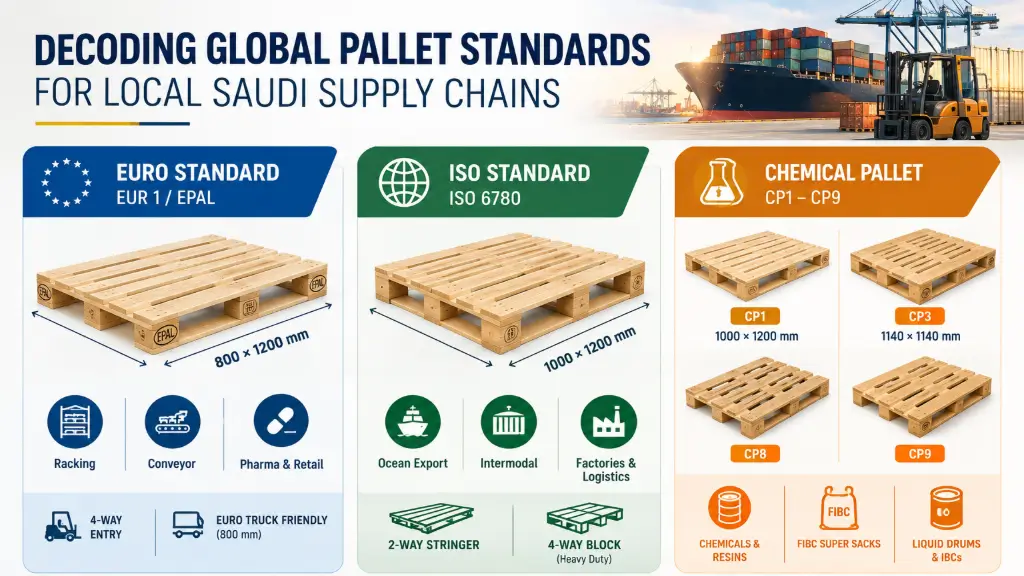
The Euro Standard (EUR 1 / EPAL)
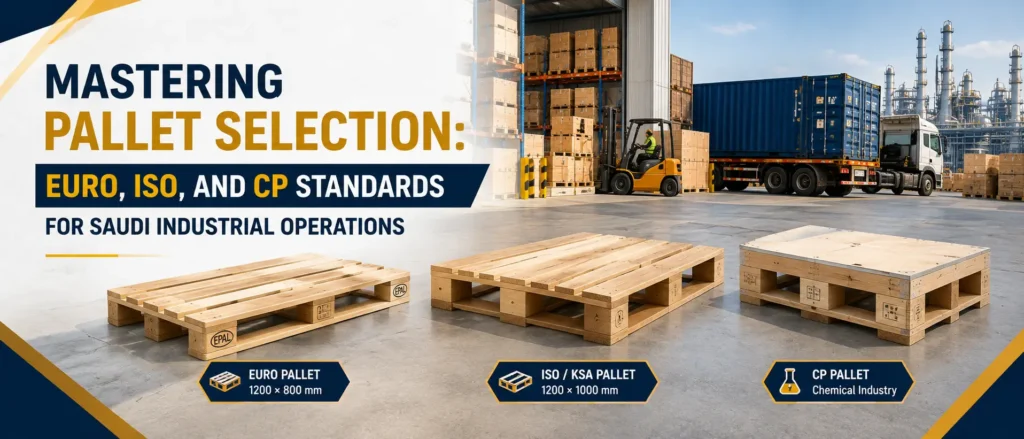
An EUR 1 pallet measures 800 x 1200 mm. It shows up a lot in European shipping. You also see it in Saudi pharma sites, shops, and automated storage systems. This pallet is made as a rigid 4-way entry block. Forklifts and pallet jacks can reach it from any side. That helps with faster moves.
Best fit for high-density racking. It also works well with conveyor lines. It suits sites that run repeatable distribution layouts. One thing to watch is the 800 mm base width. It helps you fit better in European delivery trucks. Still, when you load it into a standard 40-foot ocean container, you can end up with unused space
The ISO Standard (ISO 6780)
ISO 6780 set pallet sizes to fit better in shipping containers for sea freight around the world. In Saudi Arabia, the 1000 x 1200 mm pallet is common in factories, logistics work, and port handoff operations where goods move from one area to another quickly.
- Best Used For: This pallet works well for ocean export moves, routine freight forwarding, and moving loads by intermodal methods between Riyadh Dry Port and nearby sea routes.
- Key Consideration: Before you order, check the build type. You can choose two-way stringer pallets or heavy-duty four-way block pallets. Pick the style based on how heavy the loads will be. Explore our industrial wooden pallets for logistics and warehousing to view standard ISO-dimension configurations.
The Chemical Pallet Standard (CP1 to CP9)
Made for the European chemical sector, CP rules have become a reference point for big Saudi petrochemical plants in Jubail and Yanbu. CP1 through CP9 give pallet size guidance for certain heavy packaging jobs. The goal is to fit the load and keep it from sticking out.
- CP1 measures 1000 by 1200 mm: It works well with bagged plastic resins, raw polymer items, and boxed chemical materials.
- CP3 measures 1140 by 1140 mm: This square size is for 200-liter liquid chemical drums, bulk octabins, and intermediate bulk containers, also called IBCs.
- CP8 and CP9: use tough slotted base designs. They are made for bottom-discharge flexible intermediate bulk containers, known as FIBC super sacks. Discover how our petrochemical and plastic resin packaging solutions meet strict chemical export criteria.
3. Comparing Pallet Standards for Saudi Operations
Choosing between Euro pallets and ISO pallets in Saudi Arabia is about how they hold up in day to day work.
When chemical makers look at SABIC approved CP pallet sizes, they focus on keeping the container from sticking out over the edge. This is done so bags do not rip and drums do not get punctured while they are shipped by sea.
4. Key Factors for Industrial Pallet Selection
Static vs. Dynamic Load Capacity
People often mix up static load and dynamic load.
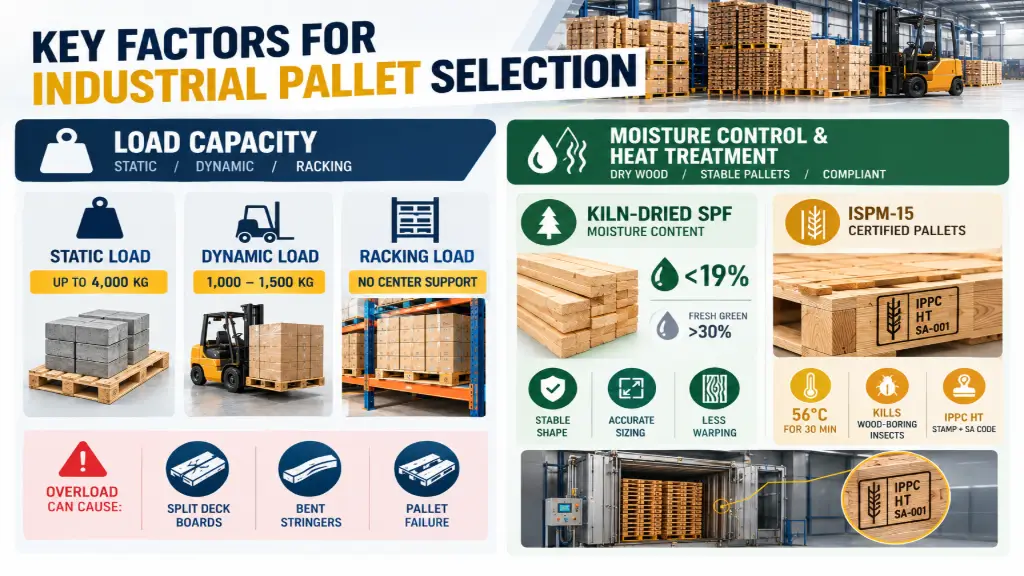
- Static load capacity means the most weight a pallet can hold while it sits still on a level floor. One example is up to 4,000 kg.
- Dynamic load rating is the most weight a pallet can carry while it is lifted and moved by a forklift or pallet jack. This is often in the range of 1,000 kg to 1,500 kg.
- Racking load capacity is the maximum weight a pallet can hold when it rests only on rack beams. There is no extra support under the center.
If you push a pallet past the dynamic limit or the racking limit, you may see split deck boards. You may also see bent stringers, and the pallet can fail when it is moved.
Moisture Control and Heat Treatment
Saudi ports and industrial areas get very hot and very damp. That mix makes it hard to store fresh timber. Because of this, wood must be seasoned before use:
- Kiln-Dried SPF Moisture Content (<19%): Fresh green boards can hold more than 30% water. If those boards dry in warm storage areas, they often warp. They can also shrink and twist. Using Kiln-Dried SPF lumber with moisture under 19% helps keep the shape steady. It also supports more accurate sizing.
- ISPM-15 Certified Industrial Pallets KSA: For pallets, ISPM 15 standards set rules must be followed. Solid wood pallets need heat treatment to reduce pest risk. During treatment, the wood core must reach at least 56°C for 30 minutes. This step helps kill wood-boring insects. After the heat process, approved pallets show an IPPC HT stamp. The stamp also includes the SA-code to confirm where the treatment was done. The stamp also includes the SA-code to confirm where the treatment was done according to SASO (Saudi Standards, Metrology and Quality Organization) guidelines.
5. Used vs. New Wooden Pallets: Evaluating Reconditioned Options
To manage supply chain budgets, many industrial facilities in Saudi Arabia evaluate used and reconditioned wooden pallets alongside new units. While refurbished pallets can offer significant cost savings for internal storage, choosing between used and new platforms requires careful operational planning.
| Feature | New Industrial Pallets | Used / Reconditioned Pallets |
| Upfront Unit Cost | Standard Market Price | 30% to 50% Savings |
| Dimensional Accuracy | Exact (±1mm Tolerance) | Minor Variations |
| ASRS Compatibility | Preferred (Zero Sensor Faults) | Manual Handling Only |
| ISPM-15 Recertification | Factory Stamped | Requires Re-treatment |
When to Use Reconditioned Pallets
- Internal Facility Stacking: Ideal for static inventory, floor storage, or closed-loop movements within localized manufacturing yards.
- Cost-Sensitive Short Hauls: Cost-effective for local, single-use transport across industrial cities where high aesthetic or automated standards are not enforced.
- Sustainability Goals: Supports industrial circular economy objectives by extending the operational lifespan of timber assets.
Operational Risks and Export Limitations
- ASRS Line Sensor Trips: Used pallets may have subtle deck deflection, missing lead boards, or wood splinters that set off optical safety stops in automated high-bay racking systems.
- ISPM-15 Stamp Invalidations: When used pallets are repaired with fresh timber, the original phytosanitary certification becomes void for international trade. For export logistics out of Jubail, Yanbu, or Dammam, reconditioned pallets must undergo full heat re-treatment to secure a valid IPPC HT stamp.
6. Regional Logistics and Compliance in Saudi Arabia
Operating across Saudi industrial centers requires matching pallet selections to local infrastructure:
Jubail & Yanbu Petrochemical Hubs
Jubail and Yanbu petrochemical areas run with tight rules for chemical use. In Jubail Industrial City and Yanbu, staff follow those steps every day. CP pallets are matched to the usual petrochemical spec setups. This helps things fit with plant conveyor paths, bagging lines, and ocean packing checks.
Riyadh Distribution & Cold Chain
Riyadh is different. It is a key inland logistics center. Warehouses there often use high racks and automated storage. Many teams choose rack able wooden pallets for Riyadh storage plans. The designs include sturdy bottom runners. That choice helps avoid dips across rack beams when pallets sit for long periods.
Dammam & Eastern Province Freight
Dammam sits near King Abdulaziz Port and other heavy industry spots. EPAL pallet suppliers in Dammam offer heat-treated pallet options. These pallets are built for sea transport. They are meant to withstand rough site handling. They also work for heavy machinery parts. They suit raw material imports too.
7. How Custom Pallet Engineering Solves Unique Supply Chain Problems
Most Euro, ISO, or CP pallets fit a lot of shop and warehouse work. Still, some jobs need more than a stock pallet. Custom timber platforms are often the better fit for odd machines, special production lines, and large equipment that will not sit safely on standard units.
When you work with a known timber packaging team, you can plan a platform that matches your cargo and use case. The main building options include:
- Custom deck boards with chamfered edges. This helps stop rips in bags during fast packing runs.
- Square and flush side frames. These reduce open spaces when a container is loaded close.
- A hardwood runner base. The high-density wood helps carry heavy points without making the unit too tall.
Getting the pallet type right is only one step. You also need to check the wood moisture and meet ISPM-15 rules. With those steps in place, facilities in Saudi Arabia can cut down on damage, avoid delays at customs, and keep automated logistics moving well.
Frequently Asked Questions
EPAL Euro pallets are 800 by 1200 mm. They are built for Europe, including common road haul and yard setups, plus many warehouse automation layouts. ISO pallets are 1000 by 1200 mm. They fit better with global sea freight packing, especially when using ocean container plans.
CP pallets are made for chemical bags, drums, and liquid packs. The pallet shape matches the common bag and drum sizes. That tighter fit helps stop overhang, so there is less risk of bag damage and fewer punctures on drums during loading and transport.
The IPPC HT mark shows the pallet was heat-treated under ISPM-15 rules. The wood core must reach at least 56°C in 30 minutes. This lowers the chance of wood pests being carried across borders, which helps with export steps and customs checks.
If the pallet is too wet, usually more than 19%, it can shrink and bend as it dries. In warm warehouses, this can lead to twisting and warping. Those changes can throw off ASRS detection, lead to rack blockages, and reduce how much weight the pallet can safely carry.