
Wooden Pallet Collars in Saudi Arabia | Modular Warehouse Storage
Most logistics directors dealing with warehouse space pressure work through the same sequence racking, mezzanine, vertical carousel. Pallet collars rarely surface early in that conversation, which is why they stay underused in operations where they would work well. Wooden pallet collars in Saudi Arabia, Eastern Province, Dammam, Khobar, Jubail, Riyadh, Yanbu & KAEC turn a standard pallet into a secure, enclosed storage unit. Hinged timber frames, nothing bolted to the floor or fixed to the wall. When the operation changes, the storage configuration changes with it, which most fixed infrastructure solutions cannot offer.
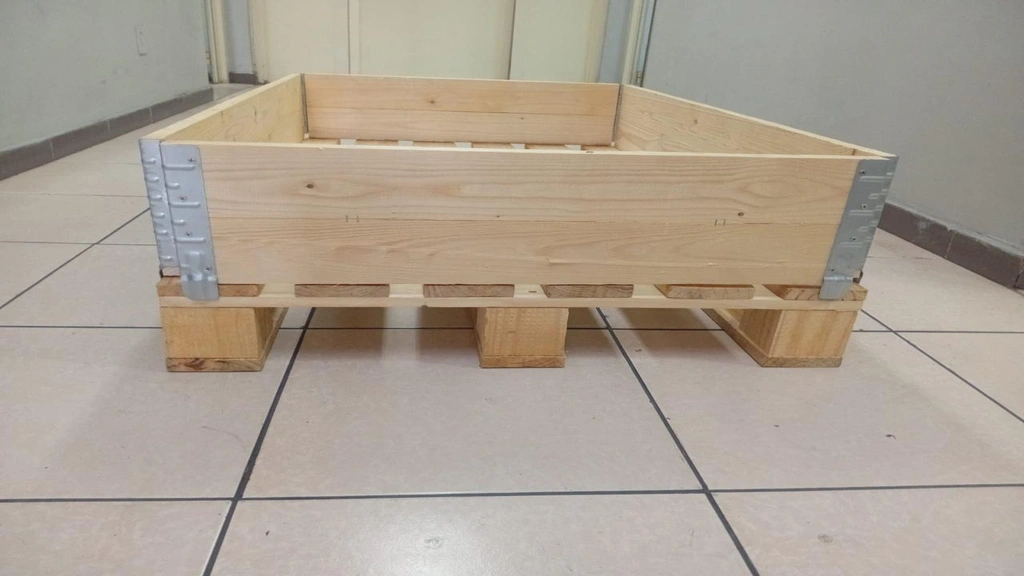
Technical Specifications, Hinged Wooden Pallet Collars
Four timber boards connected at the corners by galvanized steel hinges, that is a collar frame. It drops onto a standard pallet, locks flat against the deck, and sits there. Add a second collar on top and the storage depth doubles. A third collar takes the assembly to three tiers. Every component in that stack folds flat when it is empty, which matters when empty units need to move or store efficiently.
Where the Engineering Actually Sits
The hinge is doing most of the structural work in a loaded multi-tier stack. A corroded or undersized hinge joint introduces lateral play into the assembly. On an Aramco or SABIC site, incoming packaging goes through a physical gate inspection. Lateral instability in a stacked unit is a rejection, not a note for the next delivery.
We manufacture collar frames from kiln-dried Spruce Pine Fir (SPF) suited to the distributed load profile of collar wall applications at mid-range containment weights. Board thickness runs to specification per grade. Corner hinges are heavy-gauge galvanized steel throughout, zinc-plated alternatives lose their load tolerance in Dammam’s coastal humidity and Jubail’s industrial atmosphere within a season.
Every batch holds ±2mm dimensional tolerance. SABIC, Royal Commission, and Aramco facility gates run physical checks on incoming packaging. A collar frame outside ±2mm creates a deck fit gap, misaligns the stacking geometry, and fails that check. Holding ±2mm in production means the rejection happens at our quality check, not at your site entry point.
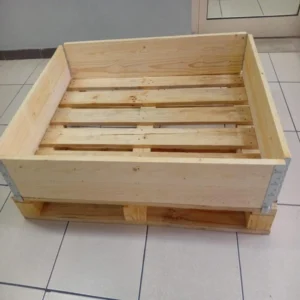
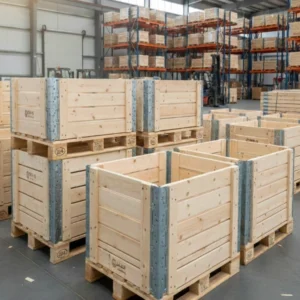
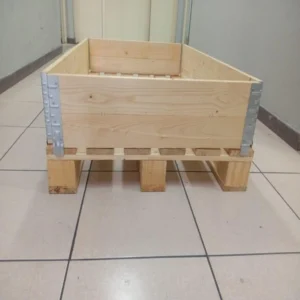
Technical Specifications, Hinged Wooden Pallet Collars
Four timber boards connected at the corners by galvanized steel hinges, that is a collar frame. It drops onto a standard pallet, locks flat against the deck, and sits there. Add a second collar on top and the storage depth doubles. A third collar takes the assembly to three tiers. Every component in that stack folds flat when it is empty, which matters when empty units need to move or store efficiently.
Where the Engineering Actually Sits
The hinge is doing most of the structural work in a loaded multi-tier stack. A corroded or undersized hinge joint introduces lateral play into the assembly. On an Aramco or SABIC site, incoming packaging goes through a physical gate inspection. Lateral instability in a stacked unit is a rejection, not a note for the next delivery.
KSA Boxes manufacture collar frames from kiln-dried Spruce Pine Fir (SPF) suited to the distributed load profile of collar wall applications at mid-range containment weights. Board thickness runs to specification per grade. Corner hinges are heavy-gauge galvanized steel throughout, zinc-plated alternatives lose their load tolerance in Dammam’s coastal humidity and Jubail’s industrial atmosphere within a season.
Every batch holds ±2mm dimensional tolerance. SABIC, Royal Commission, and Aramco facility gates run physical checks on incoming packaging. A collar frame outside ±2mm creates a deck fit gap, misaligns the stacking geometry, and fails that check. Holding ±2mm in production means the rejection happens at our quality check, not at your site entry point.
Operational Advantages, Collapsible Packaging Walls
Price the return freight on empty rigid wooden boxes and the collar system starts making sense quickly. A rigid box going back empty occupies the same truck space it did coming in full. Collar frames fold to a flat stack, one person lifts and restacks the whole set. For operations running high-volume pallet cycles between sites manufacturing to distribution, plant to port, that freight volume difference adds up across a year.
How Collars Perform Across Different Site Applications
In picking and loose parts storage, the collar frame turns a pallet into a contained picking station. Components stay within the pallet footprint during forklift movement rather than sliding to the floor and getting damaged or lost. When the picking volume changes, you add a collar tier or remove one, the pallet itself stays untouched and the reconfiguration takes minutes.
Bulk goods containment works differently. Agricultural produce, industrial components, returnable packaging, these loads need lateral support during transit that a bare pallet deck cannot provide. The collar system acts as a protective bulk box through both storage and the transit leg. When the goods ship out, the collars fold down and ride back on the return truck. No full pallet footprint of empty space each way.
Retail inventory applications are a third use case worth mentioning. Collar-fitted pallets travel to the store as a display-ready unit, the collar provides visible containment during transit and folds away at the shelf-stocking point. Single-use packaging disposal drops out of the process entirely.
Supply Capabilities, Riyadh to Dammam
Procurement teams sourcing collar frames for a distribution centre refresh find out whether their supplier holds stock or produces to order at the worst moment. The order is urgent. The timeline is fixed. A supplier without finished stock depth quotes a lead time that does not fit the window. The buyer ends up sourcing from whoever picked up the phone rather than whoever builds to spec.
Where the Engineering Actually Sits
Our Dammam facility manufactures pallet collars and holds finished stock across standard Euro and ISO configurations. Eastern Province coverage runs across Jubail Industrial City, Khobar, and the Aramco contractor logistics network. The Riyadh operation covers central province distribution centres, manufacturing facilities, and retail logistics zones, finished stock available for immediate dispatch on standard grades.
Standard stock orders placed and finalised before midday go out the same day. Facilities on tight plant intake schedules should confirm before 11:00 AM. Custom collar heights and heavy-duty configurations carry a 48 to 72 hour fabrication lead time before dispatch.
Export-bound batches are heat-treated to the ISPM 15 standard of 56°C at the wood core for a minimum of 30 continuous minutes. The IPPC stamp and certificate of treatment issue post-treatment and travel with the delivery paperwork.
Streamlined B2B Procurement Sequence
Step 1 – Submit your collar spec: pallet size, collar height, volume, and custom requirements.
Step 2 – Receive stock confirmation and pricing within one business day.
Step 3 – Confirm the order and we dispatch from Dammam or Riyadh on the agreed schedule.
Secure Your Pallet Collar Supply Run
Procurement managers with bulk collar requirements across Eastern or Central Province sites, give us the spec, volume, and delivery zone. We confirm manufacturing capacity, pricing, and lead time in one response.