
The Procurement Manager’s Guide to ISPM-15 Export Compliance in Saudi Ports & GCC Borders
The impact of a single wooden pallet can halt the entire industrial supply chain. For those in charge of procurement, logistics, and compliance in Saudi Arabia, a wooden pallet that is not certified or not stamped correctly is considered to be more than a defect in packaging; it is a serious risk.
In all phases of transport, from Jubail Industrial City through King Abdulaziz Port in Dammam, shipping oil valves in Yanbu, and shipping overland through the Batha border into the UAE, Saudi Arabia has adopted a zero-tolerance policy towards the failure of the export requirements and has strict border compliance for the export of all packaging and cargo.
Failure to meet Saudi export regulations at the ports and overland border checkpoints causes compounded delays; ZATCA (Zakat, Tax, and Customs Authority) detains the cargo, forces container fumigation, mandates re-export, and charges severe penalties.
This comprehensive guide breaks down the mechanisms behind the requirements of ISPM-15, Mawani’s terminal-specific enforcement, overland border protocols, and tactical procurement that will avoid border rejections.
1. What is ISPM-15 and Why Does It Governance Saudi Industrial Exports?
The IPPC (International Plant Protection Convention) ISPM-15 standard controls the international movement and transport of solid wood packaging materials. This control reduces the risk of pests being transported across countries in raw packaging materials. In the Kingdom of Saudi Arabia, MEWA (Ministry of Environment, Water and Agriculture), with the support of SASO and ZATCA, oversees ISPM-15 enforcement.
STAMP BREAKDOWN
- IPPC Logo: Wheat symbol indicating global standards.
- SA: Saudi Arabia (country code).
- 016: The NPPO handler registration number assigned by the Kingdom.
- HT: Heat Treatment method.
The Core Technical Standard: Heat Treatment (HT)
Before MB fumigation was banned, HT became the industry standard for complying with safety regulations for wood products. For lumber to be officially certified for heat treatment, it must be subjected to a controlled heat treatment cycle in an HT chamber:
- Core Temperature: All parts of the wood profile, especially the core, must be heated to at least 56°C.
- Duration: The core must stay at this temperature for at least 30 continuous minutes.
- Debarked Wood (DB) Rule: Any ISPM-15 certified wooden packaging, regardless of how it was treated, must be constructed from debarked wood. Pieces of bark less than 3 cm wide can remain on the wood. Pieces larger than 3 cm can remain on the wood only if the individual piece does not cover a total area of more than 50 square cm.
2. Real-World Failure Points: Why Saudi Ports & Borders Reject Timber Packaging
Understanding how compliance can be breached helps procurement managers vet suppliers even before logs are brought to a site. Saudi Ports Authority’s Mawani and ZATCA (Saudi customs) border officers inspect and verify that all incoming materials comply with a number of set standards including a variety of visual, physical and paper-based requirements.
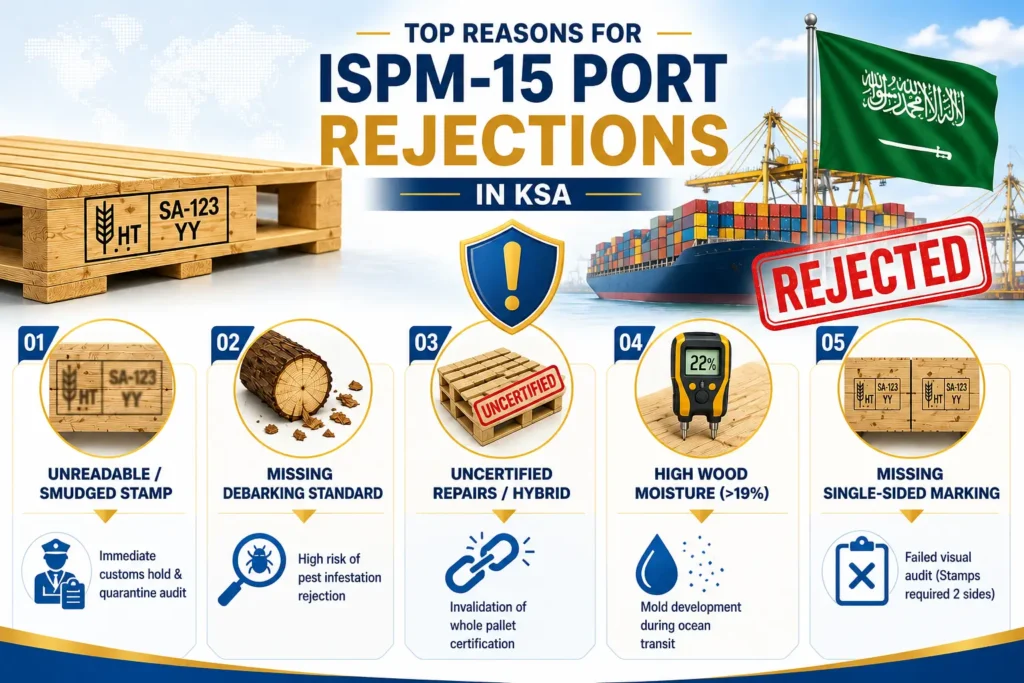
TOP REASONS FOR ISPM-15 PORT REJECTIONS IN KSA
Rejection Cause | Operational Impact at KSA Ports |
Unreadable / Smudged Stamp | Immediate customs hold & quarantine audit |
Missing Debarking Standard | High risk of pest infestation rejection |
Uncertified Repairs / Hybrid | Invalidation of whole pallet certification |
High Wood Moisture (>19%) | Mold development during ocean transit |
Missing Single-Sided Marking | Failed visual audit (Stamps required 2 sides) |
1. The "Smudged or Single-Sided" Stamp Penalty
According to the International Plant Protection Convention, ISPM-15 certification requires that all wood packing materials used in the international trade of goods bear an inspection mark that is:
- Clear and legible to the trade inspection authority;
- At least two of the four side panels of the material, preferably with a high degree of contrast;
- Applied through ink stamp or heat burn. Stenciling, hand-drawn, or removable marks are NOT permitted.
Faint ink stamps are an extremely common failure point in high-volume international shipping and lead to immediate rejection by port authorities, particularly in Middle Eastern countries like Saudi Arabia, where customs officers at Dammam and Yanbu flag shipments if the handler registration code is illegible.
2. The Hybrid/Repaired Pallet Trap
Logistics personnel often overlook the need for certified timber when repairing used wooden pallets. If replacement deck boards or stringers lack proper HT origin markings, the whole pallet loses its compliance status and will be refused at port gates.
3. Moisture Content & Fungal Growth
While ISPM-15 regulates wood packaging pests, unseasoned green lumber can develop wood packaging pest-like problems of mold and stain with wood packaging moisture content over 19%. This is especially problematic with containerized shipping as moisture tends to accumulate and mold growth accelerates. Saudi port inspectors will often reject shipments that display visible signs of degradation, even though wood packaging pests are the primary focus of ISPM-15.
3. Navigating KSA Maritime Ports: Dammam, Jubail, Jeddah & Yanbu
Stringent phytosanitary requirements are present at all Saudi Arabia’s main sea ports. Procurement teams must adapt their packaging requirements to match the cargo profile and logistical realities at the various ports.
King Abdulaziz Port (Dammam) & Jubail Commercial Port
Both ports serve most of the export and import needs for the Kingdom’s Eastern Province. This includes the export of polymers and resins, machinery, and construction materials.
Petrochemical Resin & Polymer Exports: Shipments of plastic resin packed on specialized chemical CP pallets (CP1 through CP9) must arrive with clean, undamaged HT markings. Major producers operating in petrochemical plastic resin packaging environment forbid methyl bromide fumigation due to chemical contamination risks, making kiln heat treatment mandatory.
Dunnage & Cargo Securing: Each individual piece of loose wooden dunnage used to brace cargo inside containers or on flat-racks must bear its own distinct ISPM-15 mark along its length.
Jeddah Islamic Port and Yanbu Commercial Port
Supporting logistical operations for the Western Region, including the Red Sea maritime routes and various mining projects.
- Important notes on Humidity: Lumber shipments from Europe to Asia must travel along the Red Sea. Due to the high heat and high humidity, the moisture content of the wood increases, and it begins to warp and rot while waiting to be unloaded. Lumber shipments from Europe to Asia via the Red Sea must contain softwood, typically Spruce, pine, or Fir, dried to less than 19% moisture content.
4. Cross-Border Overland Compliance: GCC Land Boundaries
Overland freight moving across the Arabian Peninsula requires navigating dual customs checks—at the Saudi export gateway and the destination country’s import gate.
Land Border Gateway | Primary Trade Corridor |
Batha Border Crossing | Saudi Arabia ➔ United Arab Emirates & Oman |
King Fahd Causeway | Saudi Arabia ➔ Kingdom of Bahrain |
Empty Quarter (Rub al Khali) | Direct Saudi Arabia ➔ Sultanate of Oman |
Khafji & Salwa Gates | Saudi Arabia ➔ Kuwait & Qatar |
The Batha Border & King Fahd Causeway Challenges
ZATCA and neighboring customs authorities, such as the UAE’s Ghuwaifat customs office, all perform thorough checks of road trucking routes.
- Physical/Visual Inspections at Borders: Road transit vehicles that pass through ZATCA or King Fahd Causeway are required to be physically examined, and there are no scanning facilities as with container transport by sea.
- Bracing Timber Friction: Heavy equipment, pipe shipments, or structural steel secured with pipe cradles & wedges or bracing planks must be fully debarked and visibly stamped. Unstamped timber results in trucks being turned back at border gates, causing severe transit delays.
- Phytosanitary Certificates: In most instances, an official timber-applied heat treatment (HT) mark, issued by the IPPC, is adequate. In some cases, agricultural and environmental customs officials across the border may request either treatment logs or a phytosanitary certificate, especially if it involves timber.
5. ISPM-15 Exempt Materials: When Can Procurement Bypass Heat Treatment?
Procurement managers can use engineered, processed wood products to decrease the tare weights of shipments and to lower risks, including eliminating the use of phytosanitary holds.
According to ISPM-15, Section 2, all wood packaging that uses only processed wood material is not required to comply with ISPM-15 treatment and marking rules. Processed wood material must be constructed by glue, heat, and pressure processes.
Material Type | ISPM-15 HT Required? | IPPC Stamp Needed? |
Solid Softwood / Hardwood | YES (56°C / 30 Min) | YES (2 Sides) |
Commercial Plywood | EXEMPT | NO |
Oriented Strand Board (OSB) | EXEMPT | NO |
Particleboard / MDF | EXEMPT | NO |
Thin Wood (Thickness ≤ 6mm) | EXEMPT | NO |
Strategic Applications for Exempt Packaging:
- Using Plywood and OSB in Export Crates: Constructing enclosed export wooden crates or wooden boxes using commercial-grade plywood or OSB panels over HT-treated frames creates a lightweight, durable structure while minimizing solid timber compliance risks.
- Air Freight Pallets: These types of composite wood pallets eliminate phytosanitary cross-border trade barriers for lighter shipments being made across the Gulf Cooperation Council, also known as the GCC, which includes countries such as the UAE and Qatar.
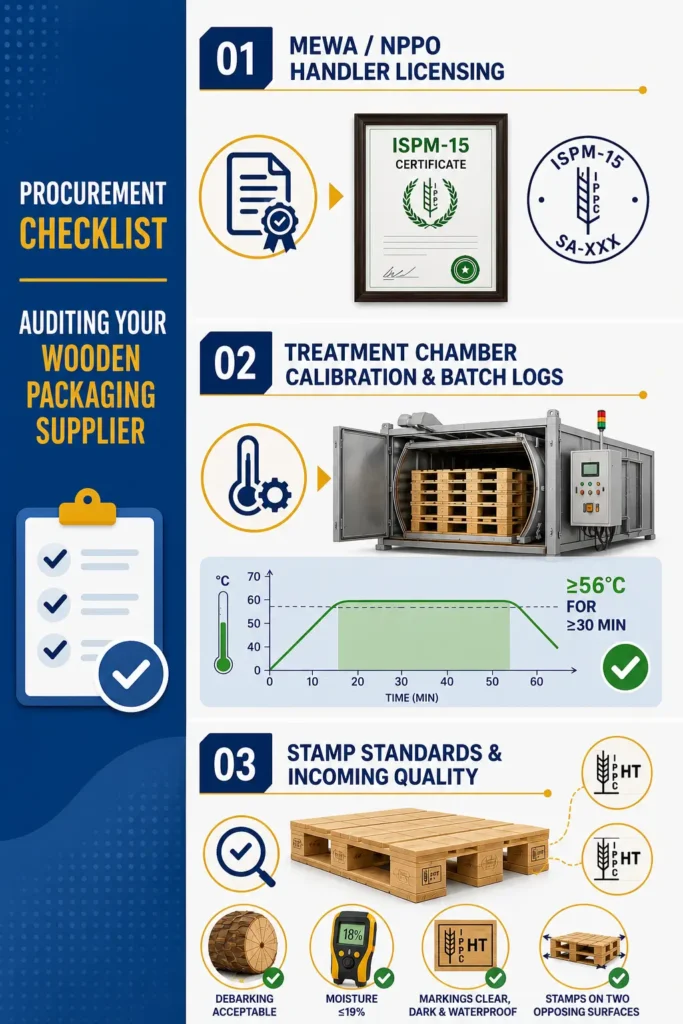
6. Procurement Checklist: Auditing Your Wooden Packaging Supplier
Procurement leaders must enforce strict vendor audit procedures to prevent customs holds. Always verify credentials before accepting delivery of wooden pallets or custom packaging.
Step 1: MEWA / NPPO Handler Licensing
Check with your packaging supplier and ensure their license, issued by the Ministry of Environment, Water and Agriculture (MEWA) in Saudi Arabia or the equivalent body of their country (the National Plant Protection Organization), is current and in good standing.
Requirement: Ask your supplier to send you a copy of their current ISPM-15 certification along with their registration number. (For example, SA-XXX).
Step 2: Get Supplier’s Treatment Chamber Calibration and Batch Logs
True ISPM-15 compliant manufacturers make their packaging using controlled drying processes in an automated dry kiln with core temperature sensing technology.
Requirement: Your supplier needs to send you the automated temperature graph for your order. Verify that the temperature recorded by every sensor was at least 56 C and was sustained for at least 30 minutes.
Step 3: Check Stamp Standards and Incoming Quality
Inspect everything upon delivery.
- Are stamps present on two opposing surfaces of each unit?
- Are the markings clear, solid, dark, and waterproof?
- Is debarking acceptable for wood standards?
- Is the moisture in the wood 19% or below (measured with a pin digital meter)?
7. Operational Comparison: ISPM-15 Compliance Execution Matrix
Compliance Dimension | Standard Solid Timber Packaging | Kiln-Dried & HT Solid Timber | Engineered / Plywood Exempt Packaging |
ISPM-15 Status | Non-Compliant (Domestic Only) | Fully Compliant (Global Export) | Automatically Exempt |
Treatment Process | None | 56°C Core Temp for 30 Min | Heat & Pressure Manufacturing |
Border Inspection Risk | High (Immediate Hold/Fumigation) | Low (Instant Visual Clearance) | Zero (Phytosanitary Exempt) |
Moisture Content | Variable (Green Timber >30%) | Standardized (<19% Moisture) | Low (<10% Moisture) |
Ideal Use Case | Local Yard Storage / KSA Domestic | Heavy Heavy-Duty Export Crates & Pallets | Sensitive Equipment & Air Freight |
Conclusion: Zero-Defect Export Logistics for Saudi Industry
Procurement leaders must enforce strict vendor audit procedures to prevent customs holds. Always verify credentials before accepting delivery of wooden pallets or custom packaging.